
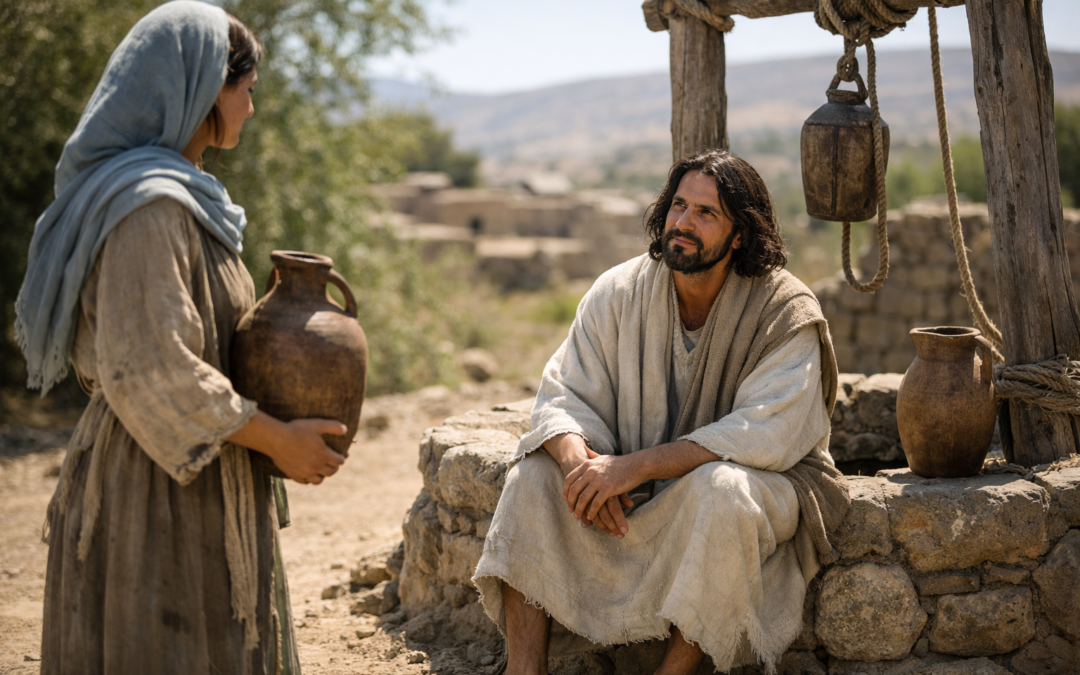
She walked alone.
Not because she preferred it, but because it was safer. The sun hung high—the hour when the other women had already drawn their water and returned to the shade, busy with their conversations. She waited for the heat, because heat does not look at you, and heat does not remember yesterday.
In her hand was a jar, and in her heart was silence. Not the gentle silence of rest, but the heavy silence of things that have lived too long without words. She came with a jar she carried with her whole life—a jar full of silence, full of longing, full of thirst she had learned to hide.
The path to the well was familiar—not only in distance, but in meaning. It was the place she came to again and again to quench her thirst, only to become thirsty once more. Water that does not last, that only helps for a moment. Like relationships that whisper promises and then disappear. Like hope that fades a little more each time.
Then she saw Him.
A man sitting there, alone and weary.
He was not sitting above the well, but beside it—at the level where people sit when they have nothing to pretend. He did not look at her with harshness, nor did He judge her. He simply waited.
What changed everything in that moment was not His presence, but His voice. Give me to drink.
The world shifts slightly in that moment. The One who created the seas asks for water. The One who commands the rain sits thirsty. God makes Himself dependent on a woman who is used to being avoided.
He does not begin with her failures or with correction—He begins with relationship. With a request gentle enough not to break her, yet honest enough not to be ignored.
She tries to keep her distance—speaking about customs, about history, about who is allowed to speak to whom. Because it is safer to talk about things than about yourself. But He does not allow Himself to be pushed away. He hears her words, but listens to the thirst beneath them.
And then He tells her that if she knew who it was that spoke to her, she would have asked Him, and He would have given her living water.
Not water you have to carry, but water that carries you.
Not water that runs out, but water that begins to flow within you.
Something in her begins to shift. She hears it, but does not yet understand it. She has spent her whole life learning to expect just enough to avoid disappointment. She knows thirst. She knows shadows. She knows survival. But this… this sounds like fullness.
Jesus gently touches the truth of her life—not to expose her, but to meet her. When He brings up her story, He does it without shame and without condemnation. Not to make her smaller, but to set her free.
He says that whoever drinketh of the water that I shall give him shall never thirst; but the water that I shall give him shall be in him a well of water springing up into everlasting life.
This is not a promise of a painless life, but a promise of a new source—a life no longer dependent on what is outside, but sustained from within.
Perhaps the deepest truth of this encounter is this: Jesus does not wait for her to get everything right. He meets her as she is—and it is that meeting that changes everything.
The wonder is not that He knew her. The wonder is that He stayed. That He did not get up and walk away when her silence began to speak. That He remained there, beside the well, with her truth.
For the first time, she is not alone at the well.
She is seen.
She is known.
And more than anything—she is not rejected.
She came to draw water, but she left without her jar. Not because she forgot it, but because she was set free. When He reveals Himself to her, saying, I that speak unto thee am he, something heavy falls from her hands.
Not only a jar, but an old way of living.
An old story.
A story of constant thirst.
The woman who avoided people now runs toward them. The woman who came in silence becomes a voice. The woman with a jar full of silence becomes a carrier of living water.
Perhaps Jesus is still sitting at your well today—at the places where you grow thirsty, where you become quiet, where you learn to survive without truly living.
He is not hurried.
He is not harsh.
He is not condemning.
He waits.
And perhaps today you hear Him say: Give me to drink.
Not because He has nothing, but because He is drawing you closer. Because sometimes, when God asks something of you, He is opening your jar—so that He can fill it with something that will never run dry.
Share the devotional with someone.


Very inspirational and so true am blessed read this thank you