
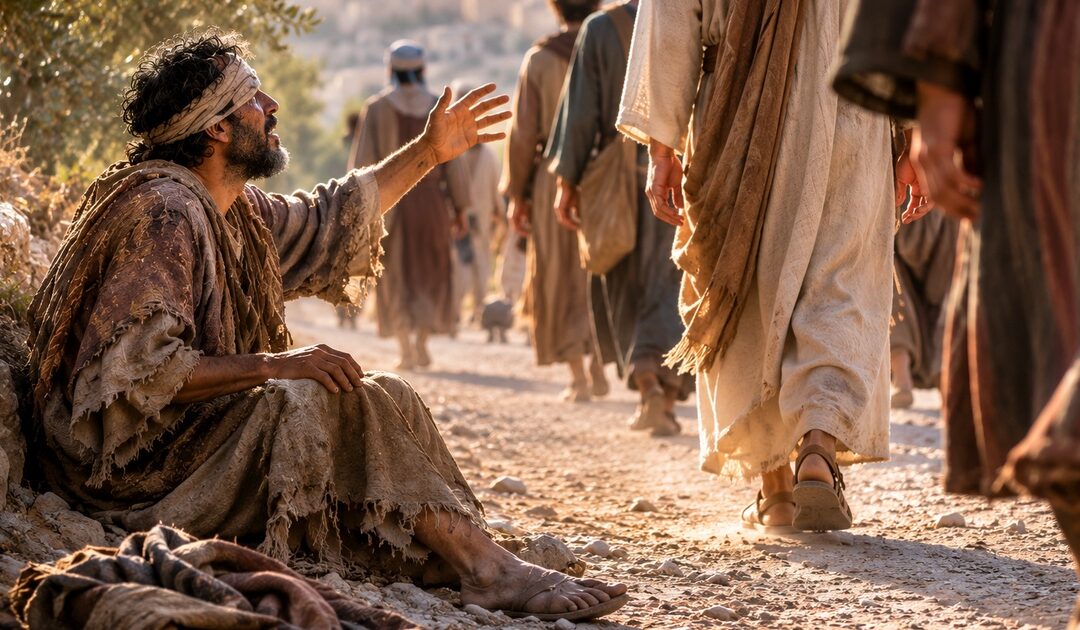
Bartimaeus is sitting beside the road when Jesus leaves Jericho. Mark introduces him to us simply: he is blind, and he is a beggar. His place in the story is quite literally beside the road. Other people walk; he sits. The crowd moves along with Jesus; Bartimaeus remains where he is, living on whatever passers-by are willing to give him.
When he hears that it is Jesus of Nazareth passing by, he begins to cry out, “Jesus, thou son of David, have mercy on me.” The crowd tries to silence him, but he only cries out more loudly. He cannot see Jesus, but he has heard enough to know to whom he is calling. The people speak of Jesus of Nazareth; Bartimaeus calls Him the Son of David. In his need, he is not merely calling out to a well-known miracle worker. He addresses Jesus by a name that reveals something of his faith.
Then something happens that can easily be overlooked among the greater events of the story. Jesus stands still.
The entire procession comes to a halt, as it were, at the cry of a blind beggar beside the road. Jesus says that he must be called, and the same people who had wanted to silence him moments before now say to him, “Be of good comfort, rise; he calleth thee.”
Mark then tells us in verse 50, “And he, casting away his garment, rose, and came to Jesus.”
It is a small action. Mark could simply have said that Bartimaeus stood up and went to Jesus. Yet he tells us that the man cast away his garment. We should be careful not to read more into such a detail than the text itself allows. Mark does not explicitly tell us why Bartimaeus did this. But within the story, the action is significant. The garment belonged to his life as a beggar. For someone in his circumstances, such a garment was not an insignificant possession. It protected him from the cold and formed part of the simple existence he lived beside the road.
When Jesus called him, Bartimaeus did not first stand up, carefully fold his garment, and make sure it was safely stored before going. He simply cast it aside and went to Jesus.
There is something striking in the simplicity of that movement. Bartimaeus could not yet see when he cast the garment aside. The healing had not yet taken place. Jesus had not even asked him what he wanted. At that moment, Bartimaeus knew only one thing, and that was that Jesus had called him.
His response therefore comes before the miracle. He leaves something of his old existence behind before his eyes are opened. Not because the garment was worthless, but because the call of Christ had now become the defining reality.
It is here that Mark’s account is so carefully told. A short while earlier, in the same chapter, another man had come to Jesus. He ran to Him, knelt before Him, and asked what he must do to inherit eternal life. Jesus looked at him and loved him. Then He said to him, “One thing thou lackest: go thy way, sell whatsoever thou hast, and give to the poor, and thou shalt have treasure in heaven: and come, take up the cross, and follow me.”
But the man went away grieving, “for he had great possessions.”
Bartimaeus has almost nothing. Yet when Jesus calls him, he casts aside what he has and comes. The rich man could see, but walked away from Jesus in sorrow. The blind man cannot see, yet he comes to Jesus. One had many possessions and could not let them go; the other’s garment lies behind him as he stands before Jesus.
The point is not that poverty automatically produces faith, or that possessions automatically mean unbelief. Jesus’ own words in this chapter go deeper. After the rich man walks away, He speaks of “them that trust in riches.” The question is where a person’s trust rests when Christ calls.
Bartimaeus comes empty-handed. He brings no claim and no merit. His first words were an appeal for mercy: “Jesus, thou son of David, have mercy on me.” When he finally stands before Jesus, the Lord asks him in verse 51, “What wilt thou that I should do unto thee?” Bartimaeus answers, “Lord, that I might receive my sight.”
The Lord gives him the opportunity to speak, to say what the problem is, even though He already knows what is wrong. Bartimaeus does not ask for a better place beside the road. He does not ask for more people to give him alms. He asks for the condition that has shaped his entire existence to be changed: “that I might receive my sight.”
Jesus answers, “Go thy way; thy faith hath made thee whole.” Then Mark says, “And immediately he received his sight, and followed Jesus in the way.”
Those final words complete the story. At the beginning, Bartimaeus is sitting beside the road. At the end, he is following Jesus on the road. His life has not simply become more comfortable; his place has changed. The man who once depended on whatever passers-by were willing to give him has now become a follower of Jesus, and somewhere behind him lies his garment.
It is possible to make too much of the garment and turn the story into a general lesson about the things we need to give up. The centre of the story is not Bartimaeus’ ability to let go. The centre is the One who stopped and called him. The garment has meaning because Jesus called. Bartimaeus’ faith was not faith in his own ability to begin a new life. It was trust in the Son of David, to whose mercy he had appealed.
That is why the order matters. Jesus passes by. Bartimaeus hears. He cries out. Jesus stands still. Jesus has him called. Only then does Bartimaeus cast aside his garment and come.
Faith does not begin here with what Bartimaeus gives up, but with the One who calls him.
Yet that faith does not leave him passive. When the call of Christ reached him, he did not hold on to his old life with one hand while reaching for Jesus with the other. He rises and comes. The garment that had been part of his life beside the road until that morning is left behind because Bartimaeus has now placed his hope in Jesus.
He did not know beforehand how Jesus would answer. But he knew to whom he had cried out: “Jesus, thou son of David, have mercy on me.”
The man who was blind had seen something of Jesus before his eyes were ever opened. And when his eyes were opened, he did not use his new sight to return to his old place beside the road. Mark simply tells us that he followed Jesus in the way.
The garment lies behind him, while Christ is before him. And the man who once sat beside the road is now walking that same road, following Jesus.
Share the devotional with someone.

