
The hidden wonder of John 6 begins with the striking words of verse 4: “And the passover, a feast of the Jews, was nigh.” At first glance, this appears to be nothing more than a simple reference to the time. Yet in John’s Gospel, there are no accidental details. The mention of the Passover takes the reader back to Egypt, to the night when the blood of the lamb was placed upon the doorposts, to the Exodus from slavery, and to the manna that God faithfully provided each morning in the wilderness. John wants us to understand that the miracle about to unfold does not stand on its own. It is the fulfilment of a story God began writing long before. What was once revealed in shadows now stands living before the people.
When Jesus saw the great multitude approaching in John 6:5–6, He asked Philip, “Whence shall we buy bread, that these may eat?” John immediately adds, “And this he said to prove him: for he himself knew what he would do.” The Lord did not ask because He was uncertain. He asked because He was revealing Philip’s heart. Philip immediately began calculating. Two hundred pennyworth of bread would not be enough. His eyes rested on the size of the need, while Jesus’ eyes rested on the omnipotence of His Father. This is often how God leads His children. He brings them to places where their own abilities come to an end so that they may discover that faith is not built upon what man can do, but upon what God has already determined to do.
Andrew found a little boy with five barley loaves and two small fishes, but in John 6:9 he added, “But what are they among so many?” Those words are the language of every person who looks only at their own resources. Barley bread was the bread of ordinary people. It was not the bread of the wealthy. Yet it was precisely this humble gift that Jesus took into His hands. Throughout Scripture, God works this way. He does not choose what is impressive. He chooses what is humble so that His glory may shine all the more brightly. The miracle is never found in the size of what is given to Him. The miracle is found in the hands into which it is placed.
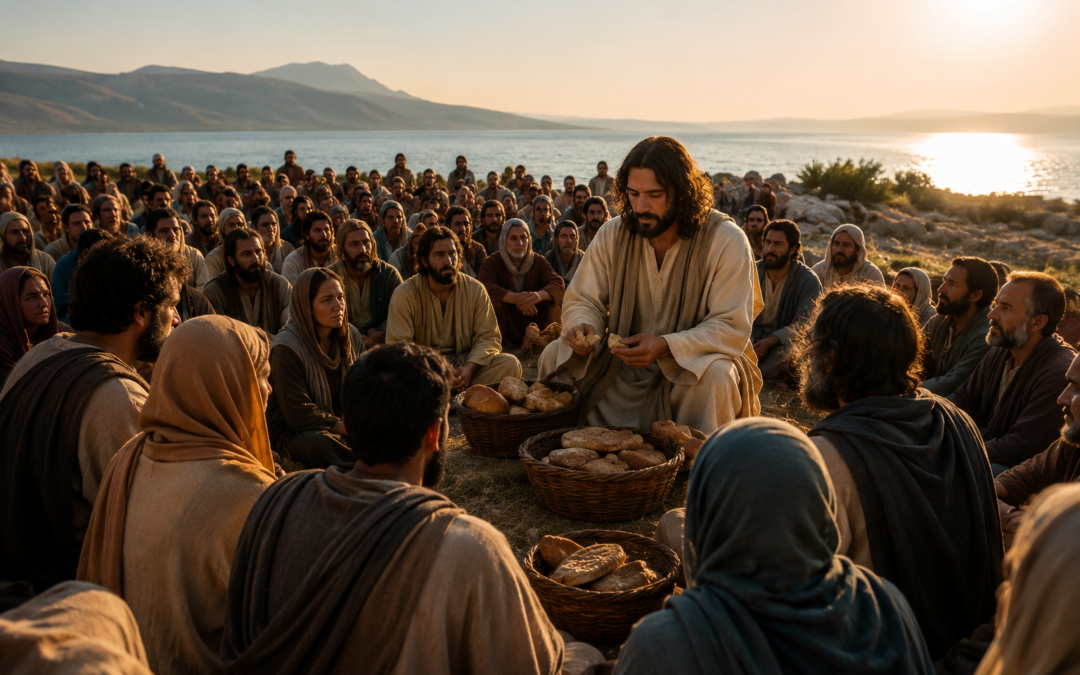
Jesus had the people sit down. He took the loaves, gave thanks to the Father, and distributed them. John simply says that everyone ate as much as they desired. This is the heart of God. He does not give sparingly. He does not merely provide enough to quiet the worst of the hunger. With Him there is abundance. After everyone had been satisfied, Jesus said in John 6:12, “Gather up the fragments that remain, that nothing be lost.” The disciples gathered twelve baskets full. The God who gives abundantly never wastes His gifts, and those twelve baskets remind us that His provision is sufficient for all the people of God.
When the crowd witnessed the miracle, they declared in John 6:14, “This is of a truth that prophet that should come into the world.” Their minds immediately turned to Moses. Just as bread had been given in the wilderness, Jesus had now given bread to the people. Yet they still did not understand that Jesus was greater than Moses. Moses never gave the manna; he was simply the servant through whom God worked. That is why Jesus later said to them in John 6:32, “Moses gave you not that bread from heaven; but my Father giveth you the true bread from heaven.” The manna was never the destination. It was always pointing forward.
When the people wanted to make Jesus king, He withdrew by Himself to the mountain. They longed for a king who would provide bread, defeat their enemies, and make life easier. They wanted a Messiah who would change their circumstances, but not necessarily their hearts. Jesus refused that crown because He had come for something far greater. He would not be crowned by a crowd, but exalted by His Father after bearing the cross. The path to His kingship would not pass through human admiration, but through self-sacrificial love.
That evening the disciples crossed the sea. A strong wind arose, and the waters became rough. Suddenly they saw Jesus walking upon the sea. Throughout the Old Testament, the sea often represents chaos and forces beyond human control. Yet Jesus came calmly across the waves and said in John 6:20, “It is I; be not afraid.” The One who gives bread is also the Lord of creation. The storm posed no threat to Him. He brought peace, not because the waves had become calm, but because He is greater than the waves.
The following day the crowd searched for Jesus again. They even crossed the sea to find Him. At first glance, it appeared to be sincere devotion. Yet Jesus looked beyond their feet and into their hearts. That is why He said in John 6:26, “Verily, verily, I say unto you, Ye seek me, not because ye saw the miracles, but because ye did eat of the loaves, and were filled.” They enjoyed the miracle, but they failed to understand what the miracle was pointing toward. They sought the Giver because He had given them bread. They had not yet discovered that He Himself is the Bread.
These words compel every person to examine their own heart. Why do we seek the Lord? Because we love Him, or because we desire something from His hand? It is possible to pray earnestly, faithfully read the Scriptures, and even serve the Lord with great zeal, while our deepest longing remains fixed on His gifts. The Lord did not speak these words to push people away. He exposed their hearts because He wanted to draw them closer to Himself. God is never satisfied with us merely receiving His blessings. His desire is that we should know Him.
That is why Jesus said in John 6:27, “Labour not for the meat which perisheth, but for that meat which endureth unto everlasting life, which the Son of man shall give unto you.” The Lord was not condemning honest work. Rather, He was revealing how easily we spend our lives pursuing what is temporary. We labour for bread that leaves us hungry again. We chase after things that will eventually perish. Meanwhile, we forget that there is only One who can give the life that never ends.
In John 6:28 the people asked Him, “What shall we do, that we might work the works of God?” This is the natural response of the human heart. We want to contribute something. We want to know what work God expects from us. But Jesus answered in verse 29, “This is the work of God, that ye believe on him whom he hath sent.” The Father did not first point to a list of works. He pointed to His Son. Faith is not an achievement by which we earn God’s favour. It is the open hand of a beggar receiving what he could never earn for himself.
Yet the crowd asked again in John 6:30, “What sign shewest thou then, that we may see, and believe thee?” It is almost unimaginable. Barely twenty-four hours earlier they had eaten from His hand until they were satisfied. Yet they asked for another sign, adding in verse 31, “Our fathers did eat manna in the desert.” Their minds were still fixed on Moses. They had not yet realised that every piece of manna that fell in the wilderness pointed forward to Christ.
Jesus answered them in verse 32, “Moses gave you not that bread from heaven; but my Father giveth you the true bread from heaven.” With those words, He shifted their eyes from Moses to the Father. Even in the wilderness it was God who provided. Moses was simply His servant. The manna could nourish the body for a day, but it could never remove sin or transform the heart. That is why Jesus said, “For the bread of God is he which cometh down from heaven, and giveth life unto the world.”
When the people responded, “Lord, evermore give us this bread,” Jesus answered with words that have brought hope to lost souls throughout the centuries: “I am the bread of life: he that cometh to me shall never hunger; and he that believeth on me shall never thirst.” Jesus did not say that He points the way to the bread or merely distributes bread. He declared that He Himself is the Bread. Everything mankind needs to be reconciled to God is found in Him. Outside of Christ, the heart remains hungry, no matter how full the hands may be.
Then Jesus lifted the veil even further and revealed something of the Father’s eternal love. He said in John 6:37, “All that the Father giveth me shall come to me; and him that cometh to me I will in no wise cast out.” This is one of the gentlest promises in all of Scripture. No one who comes to Christ will ever hear that there is no place for them. The Son receives everyone the Father brings to Him. No one is rejected because their sin is too great or their past too dark. The Father sends sinners to His Son, not to condemn them, but to save them.
Jesus added in John 6:44, “No man can come to me, except the Father which hath sent me draw him.” These words remove every reason for human boasting. No one can claim that they saved themselves. Even the very first longing for Christ is already the work of God’s grace. The Father awakens the hunger before He gives the Bread. He draws the heart before the feet ever move toward Christ. Therefore, from beginning to end, all the glory belongs to Him alone.
When Jesus later spoke about eating His flesh and drinking His blood, many of His disciples were offended. They understood His words literally and could listen no longer. They did not realise that He was pointing ahead to the sacrifice He would offer on the cross. Just as bread must be eaten to sustain physical life, so Christ must be received by faith. It is not enough merely to admire Him or appreciate His teaching. He must become the Saviour of our lives.
John then records these heartbreaking words in John 6:66: “From that time many of his disciples went back, and walked no more with him.” They stayed as long as there was bread. They left when the Lord offered them Himself. The human heart has changed very little since then. Many desire God’s gifts. Far fewer desire God Himself.
Jesus then turned to the twelve in verse 67 and asked, “Will ye also go away?” Peter answered on behalf of everyone who has truly come to know the Lord: “Lord, to whom shall we go? thou hast the words of eternal life.” He did not say that he understood everything. He simply knew that outside of Christ there is no life. That is the simplicity of genuine faith. Not that every question has been answered, but that the heart has become convinced that Jesus is enough.
The chapter closes with the mention of Judas. Even among the twelve there was one who lived close to Jesus without ever truly knowing Him. It is a sobering warning. A person may know many things about Christ and yet never belong to Him. Religion can occupy the heart, but only Christ can make the heart new.
John 6 ultimately leaves us with one question: Do we seek the Lord because He can give us something, or because He has given Himself to us? The Father did not send bread from heaven as He did in the days of Moses. He sent His only begotten Son. Therefore, the greatest miracle in this chapter is not that five thousand people were fed. It is that the Son of God gives Himself to people who first sought Him only for His gifts. That is the Father’s heart. And everyone who comes to this Bread of Life will discover that in Christ there is a fullness of grace that no hungry heart will ever exhaust.
Share the devotional with someone.

