
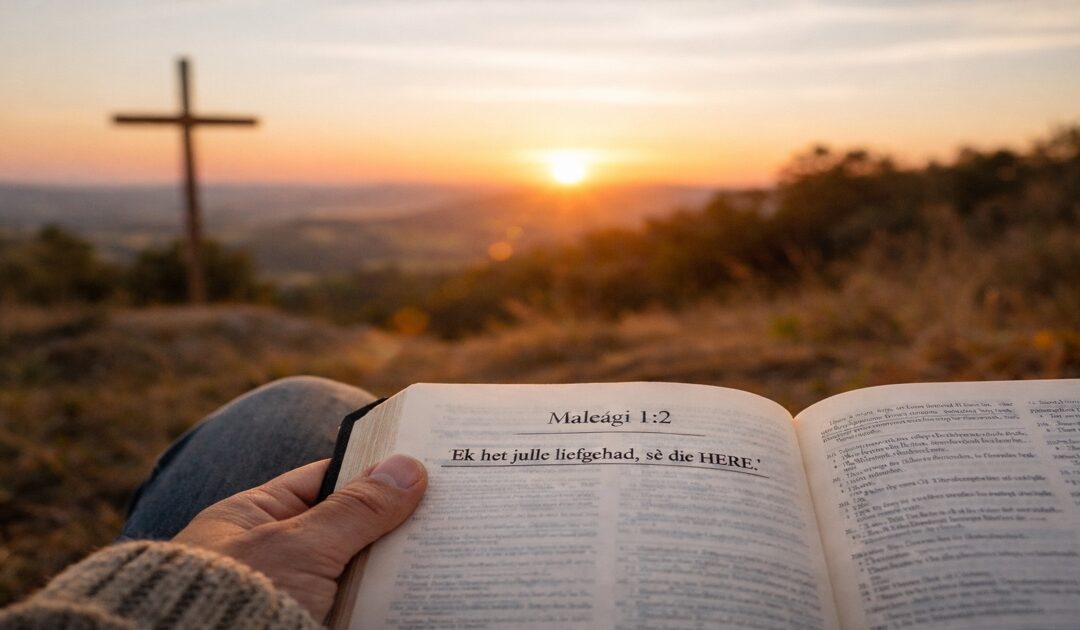
There are certain sentences in the Bible that should not be read quickly. You have to pause, and let them settle slowly into your heart.
One of those sentences appears right at the beginning of the book of Malachi. It is not a long sermon or a complicated truth—just a few simple words: I have loved you, saith the Lord.
It is God speaking. Not as a distant, cold Judge, but as a Father whose heart is turned toward His children.
What follows in Malachi 1:2 cuts deeply. The people’s response is both surprising and unsettling: Wherein hast thou loved us?
It is not just a question from the lips, but from a heart that has grown tired.
These were people who had seen much. They had known war, lived through exile, and returned to a land that no longer looked the same. The temple had been rebuilt, but the glory of former days was gone.
Life had slowly drained them.
And somewhere along the way, they began to wonder: Does God still care?
Perhaps we understand that more than we would like to admit.
Because there are moments in our own lives when we do not want to say it out loud… but deep within, a quiet question begins to whisper:
Lord… do You still see me?
Like when you pray for a long time and no answer comes.
When you bury someone you did not want to lose.
When you lie awake at night with a heavy heart.
In those moments, God can feel distant.
And yet, the book of Malachi begins with God saying, gently but clearly:
I have loved you.
Not: I will love you if you do better.
Not: I will love you once you get everything right.
But: I have loved you.
Even when their hearts had grown cold.
Even when their faith began to fade.
Even when they became weary.
The people were still doing the right things. They brought offerings, visited the temple, and kept the form of religion.
But something had changed.
God says to them, A son honoureth his father, and a servant his master: if then I be a father, where is mine honour?
It sounds almost like a sorrowful question.
Like a parent looking at a child and asking, what happened between us?
The offerings they brought were no longer their best. They brought what was sick and broken—things they would not have accepted themselves.
It was as if God was receiving the leftovers.
But the deepest problem was not the offerings.
It was the heart.
God Sees the Few
And yet, in the darkness of this book, there is a moment where light breaks through.
Malachi speaks of people who still feared the Lord. People who still spoke about Him. People who still honoured Him.
And then we read these precious words:
Then they that feared the Lord spake often one to another: and the Lord hearkened, and heard it, and a book of remembrance was written before him for them that feared the Lord, and that thought upon his name.
What a thought.
The Lord takes notice.
He hears when His people speak about Him.
He sees when someone remains quietly faithful.
He does not miss the hearts that still long for Him.
Even when it feels like no one else sees.
And then God says something that gently pulls at the heart:
And they shall be mine… and I will spare them, as a man spareth his own son that serveth him.
Not like a king who only judges.
But like a father who looks at his child with compassion.
For the One Who Is Tired
Maybe someone is reading this today with a heart that has carried the weight of feeling forgotten for a long time.
You still pray.
You still believe.
But some days, it feels like your faith is just running on routine.
If that is you, listen again to the opening words of Malachi:
I have loved you, saith the Lord.
God does not say this because your faith is always strong.
He says it because His love never changes.
Even when we grow tired, when we doubt, or when we no longer have the right words to pray—
God’s heart remains the same.
And maybe someone today simply needs to hear this again:
God has not forgotten you.
He has not erased your name.
He still looks at you with the eyes of a Father.
And perhaps—just perhaps—when you hear that again…
…something in your heart begins to soften.
And without planning it, you feel something quietly rise in your eyes.
Not because you feel guilty.
But because you remember:
God has always loved you.
Share the devotional with someone.

