
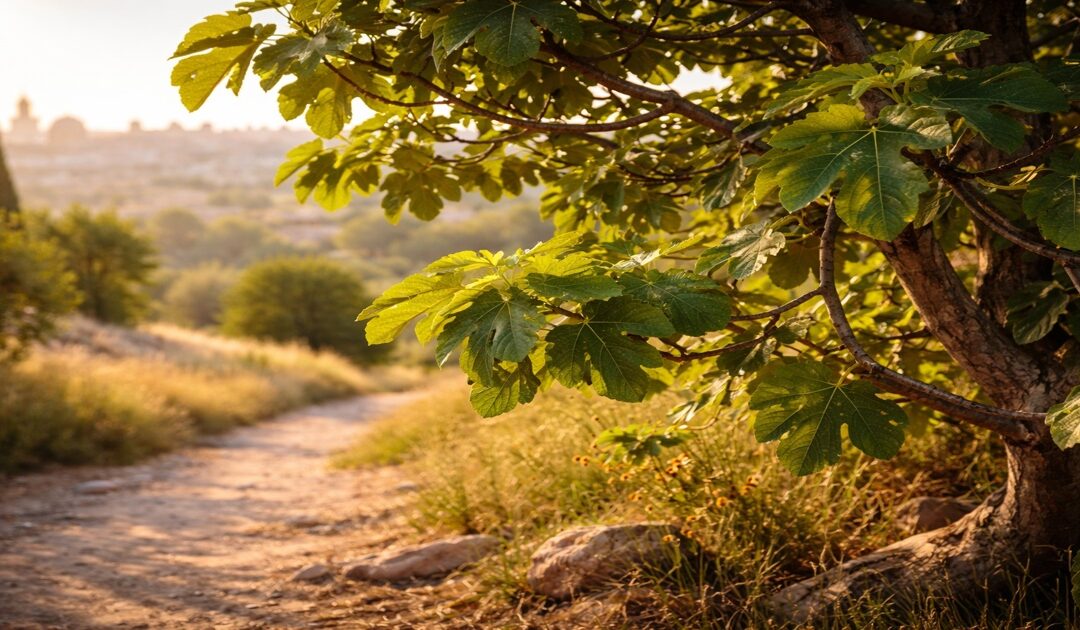
Matthew 21:18–19 says, Now in the morning as he returned into the city, he hungered. And when he saw a fig tree in the way, he came to it, and found nothing thereon, but leaves only…
This moment along the road outside Jerusalem has caused many to wonder through the centuries. Why would Jesus curse a fig tree simply because it had no fruit? On the surface, it almost seems harsh—perhaps even difficult to understand. But when we look deeper into Scripture, this scene begins to reveal something profound about the heart of God.
The first detail that draws our attention is that it happened early in the morning. Throughout Scripture, the morning is often the time when people seek God. The Psalms speak of seeking Him early and listening for His voice at dawn. But here, something is different: it is not people seeking God—God is the One who is up early, searching.
Jesus is walking along the road, and He is hungry.
These simple words reveal something deeply personal about God’s heart. God is not distant, waiting for people to find Him. He is a seeking God. From the very beginning of Scripture, we see this. After Adam and Eve sinned, God called out in the garden, “Where art thou?” Even there, at the start of the Word, we see a God who searches for humanity, because He longs for relationship.
And now, along this road, we see that same heart again. Jesus sees the fig tree, and He walks toward it.
The tree stood by the road. Many people had likely seen it. It was not hidden. It was visible, noticeable—perhaps even impressive. The leaves were full.
In that region, the early figs would usually appear at the same time as the leaves. When a tree is full of leaves, it creates the expectation that there should be fruit.
From a distance, this tree made a promise.
It looked like it had something to offer to someone who was hungry.
But when Jesus came closer and looked among the leaves, He discovered the truth:
There was nothing.
Only leaves.
This is where the deeper meaning of the story begins to unfold. The problem with the tree was not that it was dead—the problem was that it looked alive, yet was empty.
It is possible to have many “leaves” in a spiritual life. A person can appear religious. You can know Scripture. You can say the right things. You can even be very active in spiritual matters, and from a distance everything can look healthy and impressive.
But when Jesus comes closer, He looks for something else.
He looks for fruit.
There is another striking detail that makes this story even deeper. The first time the Bible mentions fig leaves is in Genesis. After Adam and Eve sinned, Scripture says they sewed fig leaves together to cover themselves.
Humanity’s first response to sin was to try and hide it.
Fig leaves became the first symbol of man’s attempt to cover guilt—to use something outward to hide something inward.
But centuries later, when Jesus comes to this fig tree, He finds the same thing again: many leaves.
It is as if the story reveals a deep spiritual truth. Humanity has not changed. There are still many leaves—many outward forms—but often very little real fruit.
God sees beyond the leaves.
He looks at the heart.
In Genesis, God also does something remarkable after Adam and Eve tried to cover themselves. Scripture says that He made garments of skin for them. That means something had to die. It was the first sign that sin cannot be covered by human effort—it requires a sacrifice.
This points forward to Jesus.
That is why it is significant that this moment with the fig tree happens in the final week before His crucifixion. The tree shows what a life looks like when it is made up only of outward appearance.
But the cross reveals God’s answer.
Humanity cannot cover itself with leaves.
That is why Jesus came—to bring the true covering for sin. He would carry the curse so that people could receive new life.
The story of the fig tree is not only a warning—it is also an invitation.
God is not looking for leaves.
He is looking for fruit—a heart that loves Him, a life that has been changed, a faith that is alive.
When Jesus looks at our lives today, He does not first look at how impressive things appear.
He looks for something much simpler:
Is there fruit?
And the beauty of the gospel is this—the One who looks for fruit is also the One who can transform a life.
Even a heart that has carried only leaves for a long time can be made new by Him.
Where Christ truly dwells, fruit will begin to grow.
And that is the fruit that delights the heart of God.
Share the devotional with someone.

