
There are books in the Bible that shout with miracles, and then there is Ruth—a book that whispers. No fire from heaven, no sea being parted—just ordinary people, and a God who works so quietly in the background that you could almost miss Him. And yet, if you look closely, you begin to see: the heart of God is present on every page.
Ruth’s story begins in loss—famine, death, and empty hands. Naomi’s world falls apart so completely that she says she no longer wants to be called Naomi, meaning pleasant or delightful, but Mara, meaning bitter, because the Almighty has dealt very bitterly with her. It is honest and raw—the kind of pain that God does not turn away from.
But then something sacred happens in Ruth 1—not a miracle, but a decision. When Orpah chooses to turn back, Ruth chooses to stay. She does not give a religious speech; she offers her life. She says, Where thou goest, I will go; and where thou lodgest, I will lodge: thy people shall be my people, and thy God my God. In that moment, Ruth is not only choosing Naomi—she is choosing the God of Israel, without guarantees and without promises of comfort.
This is where God begins to reveal His heart. He often works through people who choose to love when there is nothing in it for them—only love itself.
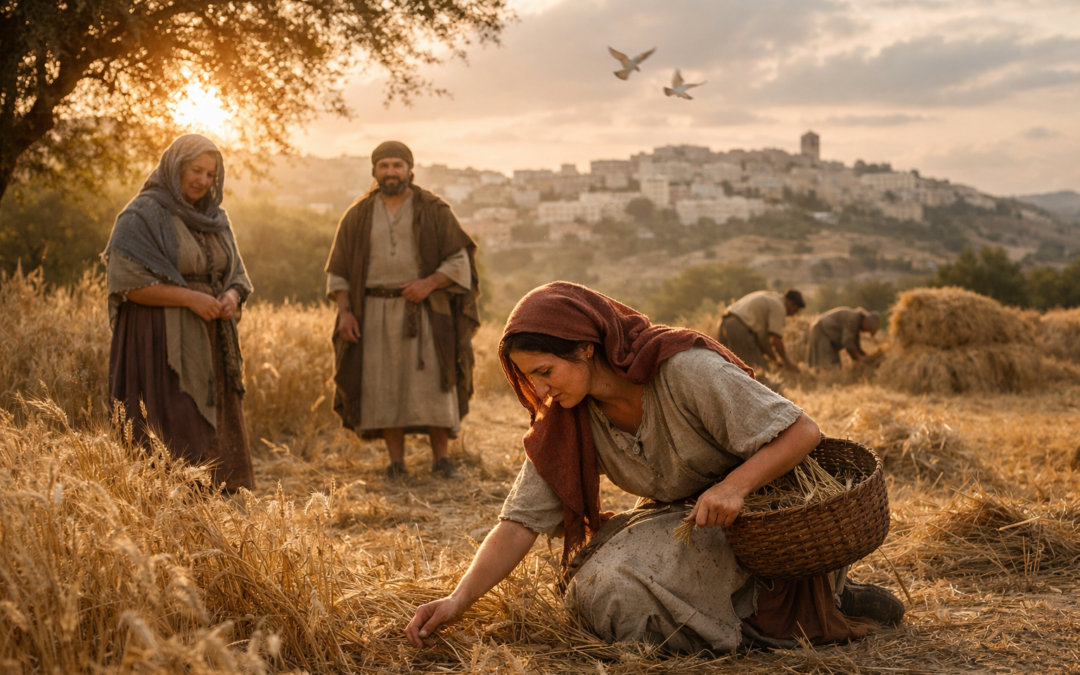
When Ruth and Naomi arrive in Bethlehem, it is harvest time. That is no coincidence, because God’s provision does not announce itself—it appears quietly, at just the right time. Ruth goes out to gather leftover grain, the lowest kind of work for the poor. And it almost seems like a passing detail when it says that she “happened” to come to the part of the field belonging to Boaz. But in God’s kingdom, there are no coincidences—only divine timing.
Boaz notices her. Not only her work, but her heart. He tells her that he has heard of all she has done for her mother-in-law—how she left her people and her father’s house to come to a people she did not know. And right there, he speaks a blessing over her—not formally, but tenderly—that the Lord would reward her, and that she would find refuge under His wings. This is the heart of God—a God who draws people under His wings long before they realise how vulnerable they are.
But Ruth’s story is not only about survival—it is about rest.
Naomi says to her, My daughter, shall I not seek rest for thee, that it may be well with thee? This is more than a plan for marriage; it is the heart of God speaking through an older woman. God is a God who seeks rest for His children—not only physical rest, but rest for the soul. A place where you no longer have to strive to be seen.
On the threshing floor, Ruth lies down at Boaz’s feet—not as manipulation, but as surrender. In essence, she is saying, “I trust you.” And Boaz responds not with abuse, but with honour. He says that all the city knows that she is a virtuous woman. Once again, we see God’s heart: He honours humility, and He protects those who entrust themselves to Him.
But even here, God takes His time. His promises are not rushed or forced into place. He works with care, doing things rightly—even when it takes longer than we expect. And when Boaz finally becomes the redeemer, Ruth is not only provided for—she is woven into something far greater than her own story.
Ruth, a Moabite woman—an outsider—becomes the great-grandmother of David. And from David’s line comes Jesus, the Redeemer. God’s heart has always been inclusive. What people exclude, God draws near. What the world rejects, God weaves into His plan of redemption.
Ruth’s life teaches us that obedience in small things carries eternal weight. That God’s hand is often most visible in the ordinary. That love, faithfulness, and humility are more powerful than dramatic miracles.
Maybe today you feel like Naomi—empty, tired, and bitter. Or perhaps like Ruth—living in a foreign place, just trying to survive. God’s heart beats for you too. He is still preparing a place of rest for you, that it may be well with you—even when you cannot yet see it.
God is never in a hurry, never late, and always on time. It is His timing—not ours.
Share the devotional with someone.

