
There are moments in life when everything goes quiet. Not a peaceful kind of quiet, but a heavy, pressing silence. The kind that comes when dreams die, when hope unravels, when you begin to wonder if God still sees you.
It is in that place that the book of Ezekiel takes you by the hand… and leads you into a world that is both unsettling and deeply beautiful.
Ezekiel was not a man living in comfort. He was a priest without a temple, a man of God in a land that was not his own. Exile had taken everything that once made sense—his culture, his calling, even his place in the world.
And yet, right there, beside a foreign river in Babylon, something happens that changes everything.
The heavens open.
Not in a soft or gentle way, but like a storm breaking. Ezekiel describes a vision that almost overwhelms the mind: fire that lives, creatures beyond description, and wheels within wheels turning without ever changing direction. Everything moves. Everything burns. Everything lives.
And in the midst of it all—a throne. And on the throne, something like the form of a man, surrounded by light and glory.
This is not only a vision of power. It is a revelation of something many people miss:
God is not confined to a place, a building, an idea, or your expectations.
The wheels within wheels, full of eyes, whisper a truth almost too vast to carry—God sees everything, and He is everywhere. Even in your exile. Even in your broken places. Even where you would least expect to find Him.
And maybe this is where the story begins for us—not with the wonder, but with the loss.
Because many of us are living in a kind of exile too. On the outside, life may look fine—but inside, we feel uprooted. We know how to function, but not how to truly live. We wear masks, but our hearts are tired.
Ezekiel’s life tells us something radical:
God does not wait for you to get everything right before revealing Himself to you.
He comes to you in the place where you have nothing left to give.
And this is where the story goes even deeper.
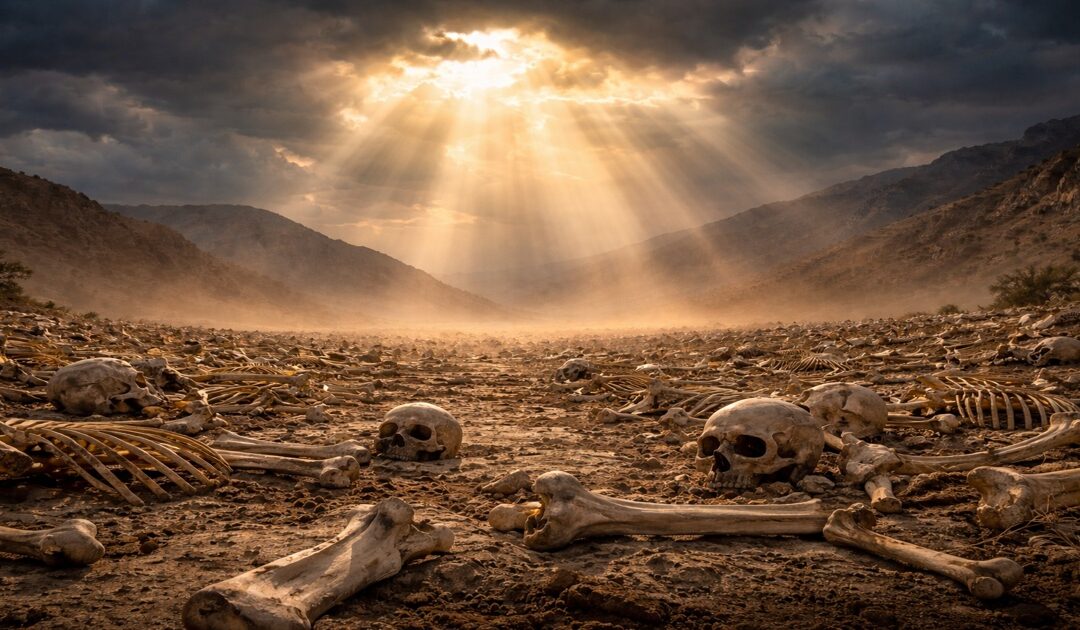
One day, God takes Ezekiel to a valley. Not a green valley full of life, but one filled with dry bones. Not just dead bones—but bones that have been dead for a long time. Bleached by the sun. Scattered. Without any sign of life.
It is the kind of scene that makes you think: there is no hope here. Nothing can be restored.
And then comes the question:
Son of man, can these bones live?
It almost feels like a cruel question. Everything in you wants to answer: no. It’s over. It’s done. It cannot be fixed.
But Ezekiel answers differently. He does not say yes or no. He says, O Lord God, thou knowest.
That is where faith begins—not in certainty, but in surrender.
Then something happens that takes your breath away.
God says to him: prophesy upon these bones.
In other words: speak life into a place where there is no sign of life. Speak hope where everything looks hopeless. Declare restoration where everything seems lost.
It makes no sense. It goes against everything logic would say. But Ezekiel obeys.
He opens his mouth.
And as he speaks—it begins.
First a rattling. Then movement. Bones coming together. Structures forming. Sinews growing. Flesh returning. Skin covering everything.
Before his eyes, the valley of death becomes a landscape of possibility.
But there is still no life.
They lie there—whole, restored… but empty.
Then God says: call for the breath.
The breath. The Spirit. Life itself.
And the moment the breath enters them, they rise. Not just as individuals—but as an army. What was once dead now stands alive, with purpose.
This is where the story hits you like a wave.
Because this valley is not just a place in a vision.
It is a mirror.
How many of us carry dry bones within us?
Dreams we buried because it hurt too much to believe again. Relationships that broke and were never restored. Faith that slowly faded under the weight of disappointment. A heart that was once open—but is now guarded, closed off, afraid to feel again.
We get used to living among dry bones. We call it “reality.” We tell ourselves, “This is just how life is.” We learn to expect less, hope less, feel less.
But God stands in that same valley and still asks:
Can these bones live?
And maybe the deepest truth of Ezekiel is not only that God can restore—but that He wants to restore. His heart is not distant from your pain; it moves toward it. He is not afraid of your brokenness—He sees it as a place for a miracle.
But here is the part we do not always want to hear:
God asks for your participation.
He says to Ezekiel: prophesy.
He could have brought the bones to life without any human involvement—but He chooses to involve a person. He chooses to use a voice—a broken, uncertain, but obedient voice.
And maybe He is asking the same of you.
Not that you must understand everything, or have perfect faith—but that you begin to speak. That you declare hope, even when you do not feel it. That you call life, even when everything looks dead.
Because there is a secret in this story:
The miracle did not begin when the breath came.
It began with obedience.
The breath—that is God’s part.
You cannot create life or control the Spirit. But you can open your mouth. You can choose not to agree with death. You can refuse to bury your own story.
And when you do—when you begin to align with God’s heart—something begins to move.
Often slowly. Sometimes invisibly. But it is real.
And then… breath.
But Ezekiel’s story does not end in the valley. It continues with visions of restoration—a new heart, a people brought back to life.
Because this is who God is:
A God who brings life.
Not only at the end of time, but now. Not only in dramatic moments, but in the quiet, hidden places of your heart.
He is not only the God of the living—He is the God who makes dead things live.
And maybe… just maybe… there is something in you today He wants to touch.
Something you gave up on long ago. Something you no longer dare to name. Something you buried under layers of acceptance and resignation.
Listen closely.
The question comes again:
Can this live?
And maybe your answer is not a confident “yes.” Maybe it is not even faith as you know it.
Maybe it is just a whisper:
“Lord… You know.”
And that… is enough.
Because in that moment, the heavens begin to open again.
Not necessarily with fire and wheels—but with something even more powerful:
The quiet, unstoppable movement of the Spirit of God.
Breath over bones.
Life returning.
And a heart… beginning to beat again.
Not because everything is perfect—
but because He is there.
And where He is…
life is inevitable.
Share the devotional with someone.

